


Digital trust, banking’s true asset: the role of cybersecurity
19 de November de 2026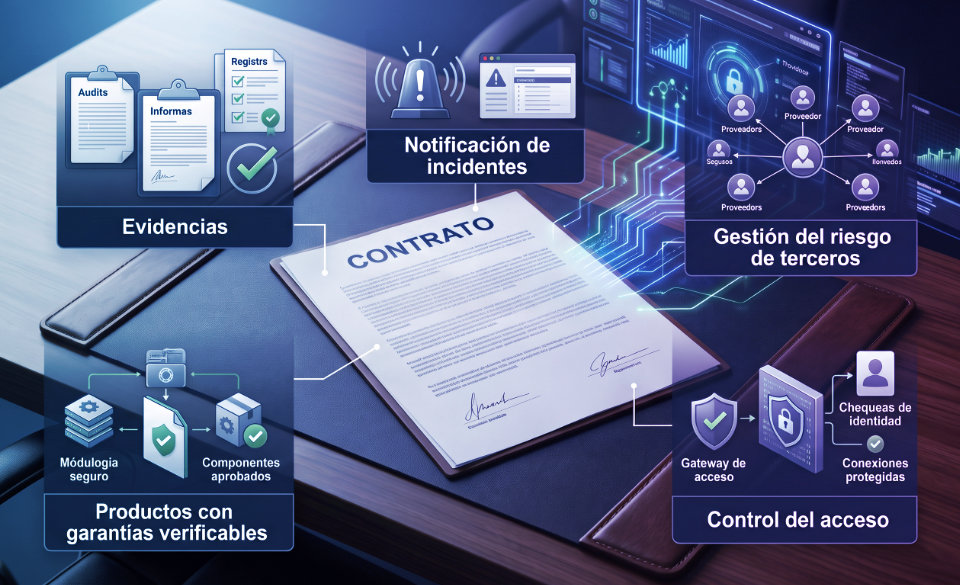
According to the 2026 Study on Cybersecurity in the Supply Chain by the Spanish Logistics Center and the Zaragoza Logistics Center, only 43% of the companies surveyed have a formal cybersecurity strategy for their supply chain. Another 43% do not have one, and 13% are developing it.
It is an uncomfortable figure, because risk no longer stays within your own perimeter. It extends to suppliers, technology partners and any actor connected to the chain. And contracts have started to reflect it.
The provider is no longer “external”
For years, a contract with a technology provider covered deadlines, price and service levels. Security was, at most, a generic clause at the end of the document.
That is coming to an end. When a provider manages systems, accesses production environments or touches critical infrastructure, its level of protection becomes part of the customer’s risk. That is why supply chain security is moving from being a good practice to becoming a contractual requirement.
Two frameworks pushing in the same direction
NIS2. Directive (EU) 2022/2555 includes supply chain security, including the relationship with suppliers, among the risk management measures that essential and important entities must adopt (Article 21). In Spain, the transposition is not yet law: the Draft Law on Cybersecurity Coordination and Governance, approved in January 2025, is still going through the legislative process, and Royal Decree-Law 12/2018 remains in force. But the content of the draft already shows the direction: supply chain risk management, periodic supplier assessments and audits, and incident notification plans.
National Security Framework (ENS). In the public sector, Royal Decree 311/2022 requires that contract specifications include the requirements needed to ensure compliance with the ENS. For the provider, this means that demonstrating compliance is a condition for winning contracts, not an added value. In addition, the ENS provides that the acquisition of security products should rely on the Catalogue of ICT Security Products and Services (CPSTIC) of the CCN.
What contracts are starting to require
Without waiting for national legislation to be finalized, the clauses already appearing in tenders and contracts revolve around five ideas:
- Evidence. Certifications, audits and reports that demonstrate the measures applied.
- Incident notification to the customer within fixed deadlines.
- Third-party risk management, including subcontractors.
- Products with verifiable guarantees, for example, those included in official catalogues such as the CPSTIC.
- Access control to the customer’s systems.
The point where everything is decided: access
Of the five, the last one prevents the most incidents. In practice, almost every technology provider needs to access something: a server, an administration console, an industrial plant. The question a demanding customer asks is not just “who are you?”, but “where are you accessing from, with what device and under what policy?”.
This is where a solution like Endurance adds the most value, especially in companies where the supply chain is key. In energy, industry, telecommunications or public administration, dozens of providers need access to the most sensitive systems. Endurance, the first Remote Shielded Workspace (RSW), brings together in a single solution key functionalities to protect access to assets of all kinds of corporations:
- Zero Trust on every access. Endurance is based on the Zero Trust principle for the accesses it manages: no request is taken for granted, and each one is verified against the company’s policies. Those policies apply to any requester, and access is granted or denied accordingly.
- Multilayer security on a single platform. It integrates PAM, VDI, IAM and DLP functionalities, so that third-party access is governed from a single point.
- Auditable sessions. Every session generates a record with full traceability. It is a guarantee of what each user does when accessing the company’s assets.
- Protection of the asset, not the endpoint. The endpoint can be compromised without affecting the connection or the asset, and there is an air gap between the two, in addition to channel encryption.
- Verifiable backing. Endurance is included in the CCN’s CPSTIC catalogue thanks to its certifications, a reference that the ENS contemplates for acquiring security products.
For the customer, it is concrete contractual evidence: they can demonstrate who accessed what and what they did. For the provider, it is the way to enter a project without access being the reason for being left out.
Compliance comes as a result
There is a wrong way to approach this change: starting with the list of requirements and looking for a patch for each one. The more solid way is the opposite. Those who truly protect access to their critical assets arrive at audits with the evidence already generated. Compliance is a consequence of that protection.
Where to start
- Take an inventory of the providers with access to your systems and classify them by criticality.
- Review what your contracts currently say about remote access, incident notification and subcontractors.
- Define a single access policy for third parties and require that it be applied without exceptions.
- Ask your providers for verifiable evidence, and prepare your own.
At Cosmikal, a Spanish manufacturer of cybersecurity solutions, we designed Endurance so that protecting access to critical assets is the foundation on which everything else is built. If you want to see how this translates into a contract or tender specification, contact our team.
Sources
- 2026 Study on Cybersecurity in the Supply Chain (Spanish Logistics Center and Zaragoza Logistics Center), reported in Infobae.
- Cuatrecasas, Cyberattacks on critical sectors: waiting for NIS2 (26/10/2026).
- Cuatrecasas, Compliance Corner.
- BOE, Royal Decree 311/2022, regulating the National Security Framework.
- MUFACE, Supplier management standard.
- Gobierto Contratación, The ENS in tender specifications (Art. 2.3 of RD 311/2022).