DORA: the regulation reshaping digital resilience in the European financial sector
12 de March de 2026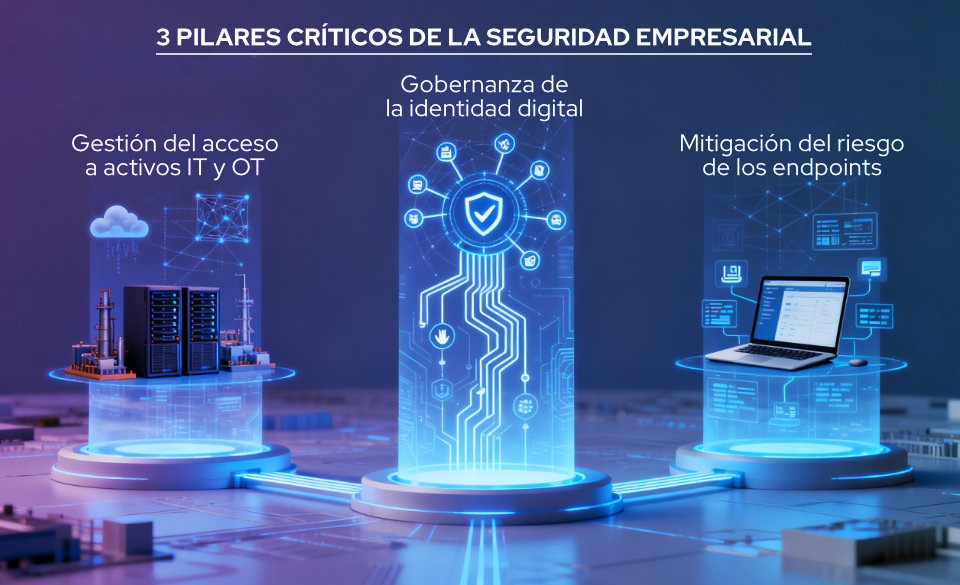
Access to assets, digital identity, and containment of endpoint risk
Corporate security architecture has undergone a profound transformation over the last decade. Traditional models based on rigid network perimeters, static segmentation, and location-based access control have become obsolete in a landscape characterized by hybrid infrastructures, connected industrial environments, widespread remote work, and an ever-expanding attack surface.
Today, a modern organization must simultaneously protect:
- corporate IT infrastructures
- industrial OT environments
- cloud assets
- IoT devices
- internal applications
- business APIs
- third-party and supplier access
- privileged administration environments
This structural complexity is compounded by a historical issue in the evolution of cybersecurity: technology solutions have evolved in a fragmented way.
Multiple independent platforms
To address specific risks, multiple independent platforms have been deployed:
- identity management solutions (IAM)
- privileged access management systems (PAM)
- secure remote access platforms
- endpoint detection and response solutions (EDR)
- multifactor authentication systems
- privileged session management tools
- access control solutions for OT environments
Although each of these technologies fulfills an important function, the final result is often a dispersed architecture, difficult to operate, difficult to integrate, and with significant security blind spots.
This approach creates several structural problems:
- Fragmented access governance
- Excessive dependence on endpoint security
- Direct exposure of critical assets to the network
- Operational complexity in audits and regulatory compliance
- Unnecessarily broad attack surfaces
In this context, many organizations are beginning to rethink their security architecture from a more fundamental perspective: access control as the central element of the security model.
Instead of addressing problems independently through specialized tools, three critical challenges—historically managed separately—are unified within the same architecture:
- management of access to IT and OT assets
- governance of digital identity
- mitigation of endpoint-originated risk
This technological convergence makes it possible to transform access into a comprehensive control mechanism over corporate systems, significantly reducing the organization’s exposure surface.
The structural access problem in modern infrastructures
In any complex organization, there is one common element across all systems: access.
Regardless of the type of asset (servers, industrial systems, databases, network devices, or cloud platforms), there is always a mechanism through which users, administrators, or automated systems interact with those resources.
Historically, these accesses have been performed through direct connections:
- SSH to servers
- RDP to workstations
- database connections
- access to industrial systems through specialized clients
- remote administration tools
- VPN tunnels to internal networks
This model presents a fundamental security issue: assets are exposed to the network and to the user’s endpoint.
Exposed assets
When a user establishes a direct connection to a system, several potentially dangerous situations arise:
- The user’s endpoint comes into direct contact with the asset
- Credentials must be managed or stored on the device
- The session runs outside a fully controlled environment
- The target system is exposed to attacks originating from the endpoint
This model has worked for decades, but the exponential growth of advanced attacks has revealed its limitations.
The most significant security incidents in recent years share one or more of the following factors:
- Compromise of privileged credentials
- Lateral movement within the network
- Compromise of administrative endpoints
- Abuse of legitimate remote access
- Ransomware propagation through privileged sessions
In many cases, the attacker does not need to exploit the target system.
It is enough to compromise the device from which the access is performed.
First pillar: secure access management for IT and OT assets
One of the biggest challenges in enterprise security today is simultaneously protecting IT and OT infrastructures.
For years, these environments were managed separately. Industrial networks were isolated, used proprietary protocols, and were considered relatively secure due to their physical separation.
That paradigm no longer exists.
Industrial digitization, remote monitoring, maintenance of critical infrastructures, and IT/OT convergence have caused traditionally isolated systems to become connected to corporate networks and even the internet.
This includes assets such as:
- SCADA systems
- industrial PLCs
- engineering workstations
- energy control systems
- telecommunications infrastructures
- industrial IoT devices
- process control platforms
Modern security models
Many of these systems were designed without modern security models, making them particularly vulnerable to uncontrolled access.
Security in these environments often depends on measures such as:
- network segmentation
- industrial firewalls
- remote access VPNs
- basic authentication
While these measures provide a certain level of protection, they have a fundamental limitation: the asset remains accessible from the network.
Endurance eliminates this exposure through a simple but extremely powerful architectural principle: users never access assets directly.
Instead of establishing a direct connection between the user’s endpoint and the target system, Endurance introduces a fully controlled intermediary environment that mediates all interactions.
In this model:
• The asset remains isolated from user devices
• Sessions run in a secure environment
• The system fully controls the interaction between user and resource
This approach enables advanced controls such as:
• granular role-based access
• audited sessions
• activity recording
• command control
• logical resource segmentation
The asset is no longer exposed to the corporate network or the user’s endpoint.
Instead, it becomes protected inside a shielded environment where every interaction is governed by strict security policies.
Second pillar: identity as the core of the security architecture
The evolution of digital infrastructures has caused a radical shift in the concept of the security perimeter.
In the past, the corporate network acted as a clear boundary between the secure environment and the outside world. Users accessing from within the perimeter enjoyed greater privileges than external connections.
Today that model is no longer secure.
Organizations operate in distributed environments where:
• users work from remote locations
• systems are deployed across multiple clouds
• third-party access is common
• applications are exposed through APIs
In this context, the traditional perimeter loses meaning.
The new perimeter is digital identity.
Every interaction with a system must be linked to a verifiable, authenticated, and governed identity.
Endurance places identity at the center of its security model through an identity management system that enables:
- strong authentication with integrated MFA
- integration with corporate directories
- centralized management of human and non-human identities
- role-based access control
- full traceability of activities
This allows organizations to maintain a precise view of who accesses which resource, when, and under what conditions.
Unlike traditional authentication models, identity in Endurance does not simply validate the user at login. It governs the entire interaction with protected systems.
Each session is associated with:
- a verifiable identity
- a defined set of permissions
- a complete activity record
This model provides a solid foundation for compliance with demanding regulatory frameworks such as:
Third pillar: containment of endpoint-originated risk
Despite massive investments in endpoint protection solutions, operational reality shows that user devices remain the most common entry point for attackers.
Endpoints present an extremely broad attack surface due to factors such as:
- user-installed software
- operating system vulnerabilities
- phishing attacks
- advanced malware
- supply chain compromises
Even in organizations with mature security policies, it is virtually impossible to guarantee that all devices are completely free of threats.
Endurance approaches this problem from a radically different perspective.
Instead of attempting to eliminate endpoint risk entirely (which is practically impossible), the system contains that risk.
The access architecture is designed so that the user device never establishes a direct connection with protected assets.
Sessions run within an isolated environment where interaction with the user occurs through interface event transmission:
- keyboard events
- mouse events
- video transmission
- audio transmission
This means the user’s endpoint acts only as an interaction terminal, not as a direct access point to the infrastructure.
The security implications of this model are profound.
Even if the endpoint were compromised by advanced threats such as:
- ransomware
- keyloggers
- remote administration malware
- lateral movement tools
the attacker would remain confined to the local device and would not be able to:
- directly access corporate assets
- execute commands on protected systems
- extract real credentials
- move laterally within the infrastructure
The endpoint ceases to be a gateway into the organization.
Unifying security, governance, and operational control
The real value of this architecture does not lie only in each mechanism individually.
Its impact emerges from the integration of all of them within a single secure access model.
When combined:
- asset access control
- identity governance
- endpoint risk containment
the result is an architecture capable of significantly reducing the organization’s attack surface.
Instead of relying on multiple independent tools, organizations can manage access to their critical systems from a single environment where:
- all identities are governed
- all access is controlled
- all sessions are auditable
- assets remain isolated from endpoints
This model not only improves security but also greatly simplifies the daily operation of cybersecurity teams.
Conclusion: access as the new control point of security
In a digital environment characterized by distributed infrastructures, sophisticated threats, and growing regulatory demands, organizations must rethink their security models from a more structural perspective.
Protection of critical assets can no longer rely solely on perimeter controls or endpoint security.
System access has become the most critical control point in the entire architecture.
Endurance addresses this challenge through an approach that integrates three fundamental pillars of modern cybersecurity:
- secure control of access to IT and OT assets
- centralized identity management
- containment of endpoint-originated risk
By unifying these elements within a single shielded access architecture, organizations can significantly reduce their exposure surface and establish a security model that is far more coherent, governable, and prepared for modern threats.
Because ultimately, in any complex system, there is one difficult truth to dispute:
Who controls access controls the system.
And in modern cybersecurity, controlling access means controlling the security of the entire organization.