Password management vs. passwordless environments: the future of access to corporate systems
12 de February de 2026
Cybersecurity audit: a guide to protecting your company’s most valuable asset
26 de February de 2026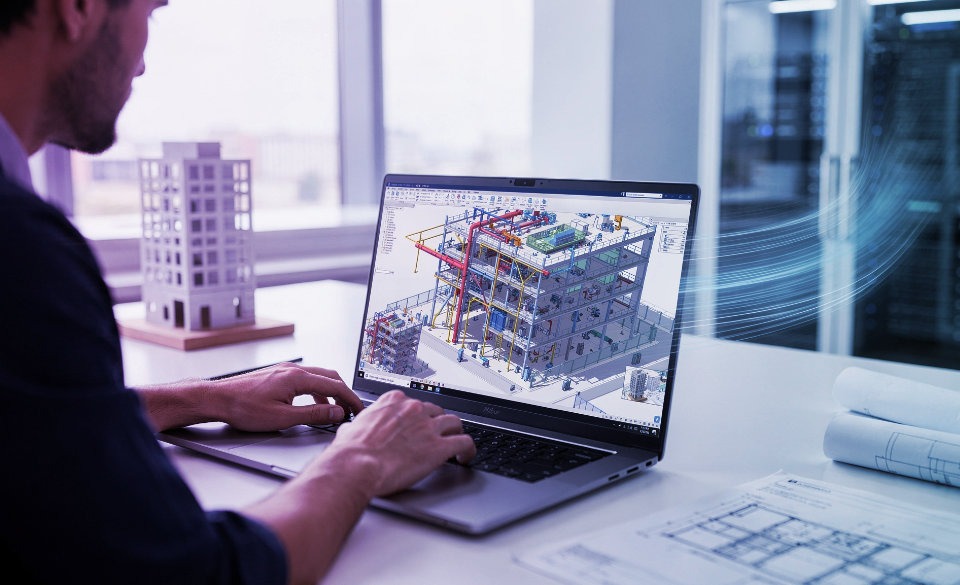
For years, the AEC (Architecture, Engineering & Construction) sector has remained anchored to a rigid technological model: powerful, expensive workstations physically tied to the user’s desk. Not due to a lack of vision, but because of a historical dependency on the GPU. 3D design, structural analysis, and BIM workflows required local graphics power, low latency, and full compatibility with professional software. The consequence was clear: while other departments moved toward the cloud, architects and engineers remained “tied to the hardware.”
GPU virtualization (vGPU) definitively breaks this paradigm. It enables graphics power to be decoupled from the physical workstation, centralized within secure infrastructure, and delivered as a service. At Cosmikal, we are not talking about teleworking or conventional remote desktops: we are talking about creating Shielded Workspaces that fully leverage vGPU, ensuring scalability, governance, and security by design.
From local workstations to ubiquitous graphics power
The problem with traditional workstations is not merely financial. It is structural. Each device represents high CAPEX, immediate depreciation, forced refresh cycles, and a security risk that is increasingly difficult to justify in 2026. Additionally, talent mobility (which is no longer optional) turns this model into an operational constraint.
With vGPU enabled within shielded workspaces, the GPU ceases to be a physical asset assigned to a single individual and becomes a centralized resource, available on demand and adjustable by user profile. The user accesses their graphical environment with the same power as a local workstation, but without data or hardware leaving the controlled perimeter. Location becomes irrelevant; performance does not.
Technical anatomy of a secure vGPU environment
To understand why a properly designed vGPU architecture surpasses VPNs or conventional remote desktops, one must examine the technical layer. These infrastructures use datacenter-class GPUs, such as NVIDIA’s professional ranges, engineered for intensive graphics virtualization.
On top of the hypervisor, a vGPU manager partitions the physical GPU into multiple fully isolated virtual instances. Each user receives a guaranteed allocation of graphics memory (VRAM), without oversubscription or degradation. This is critical: BIM, 3D CAD, and rendering applications are highly sensitive to memory contention.
The guest operating system detects a real GPU; there is no emulation or intermediary layer that compromises compatibility with DirectX, OpenGL, or Vulkan. Compute and ray-tracing cores are shared in a controlled manner, enabling full use of advanced professional software features without errors or limitations.
Remote visualization without perceptible latency
The second technical pillar is the visualization protocol. In a modern vGPU environment, “data” does not trave, pixels do. The image generated by the GPU is hardware-encoded and transmitted to the endpoint using graphics protocols optimized for low latency and high visual fidelity.
As a result: a fluid experience even under demanding scenarios: camera movements, aggressive zooming, complex regenerations, or simultaneous work with large models. The endpoint acts as a thin client: it stores no information, processes no geometry, and does not represent a data exfiltration vector. If network conditions fluctuate, the system dynamically adjusts quality and throughput to maintain consistent interaction.
Security and data sovereignty: the definitive argument
From a security perspective, the traditional workstation model is vulnerable. Files reside on local disks, access is difficult to audit, and the loss or theft of a laptop can escalate into a critical incident.
With vGPU enabled on Endurance,Cosmikal’s shielded workspace, intellectual property never leaves the data center. Models, drawings, and projects are processed and stored in a centralized, protected, and auditable environment. The user views the result but does not download it. Policies can prevent USB usage, clipboard copying, or any form of unauthorized exfiltration. If an employee leaves the company or loses their device, revoking credentials is sufficient: the impact is null.
This approach also facilitates regulatory compliance. Access traceability, environment segregation, and evidence generation make the solution a strategic asset for audits, sensitive projects, or regulated sectors.
Real performance in professional software
In daily operations, the difference is immediately noticeable. Tools such as Autodesk Revit open central models faster because the virtual desktop connects directly to high-speed file servers. In AutoCAD, pan and zoom remain fluid even in dense drawings with multiple references. Solutions like SolidWorks allow work with complex assemblies without frame drops or graphical freezes.
In rendering tasks, heavy processes can run in the background without interrupting user activity, thanks to advanced GPU profile management within the hardened workspace.
Technical comparison: traditional workstation vs. vGPU in Shielded workspace
| Criterion | Traditional Workstation | vGPU in Cosmikal Shielded Workspace |
| GPU Location | User’s physical device | Centralized, secure data center |
| Cost Model | High CAPEX and depreciation | Scalable OPEX based on usage |
| Scalability | Limited to purchased hardware | Profile adjustments in minutes |
| Technology Updates | Requires new hardware purchases | Transparent and centralized |
| Remote Access | VPN + remote desktop | Hardened Remote Workspace (RSW) |
| Performance | Device-dependent | Dedicated, guaranteed VRAM |
| Data Security | Data stored on endpoint | Data never leaves the hardened DC |
| Audit & Traceability | Very limited | Complete and centralized |
| Business Continuity | High physical dependency | Operable from any location |
| Energy Efficiency | High distributed consumption | Centralized optimization |
ROI, efficiency, and operational sustainability
Total cost of ownership clearly demonstrates the superiority of graphics virtualization within hardened remote spaces: simplified IT support, centralized updates, and elimination of physical logistics. Centralization also improves energy efficiency: fewer high-consumption devices, reduced heat generation, and optimized resource utilization. Sustainability becomes a natural consequence of well-designed and secure architecture.
Conclusion: engineering and design without physical constraints
GPU virtualization is the natural evolution of a sector that demands flexibility, security, and control without sacrificing performance. It enables teams to scale within hours, radically protect intellectual property, and deliver a high-level professional working experience.
Cosmikal does not sell vGPU; it enables Shielded workspaces that allow vGPU to operate at full capacity, securely and seamlessly, redefining how 3D design, engineering, and BIM are performed. Architecture no longer depends on a tower under the desk; it depends on a well-designed, hardened structure.
At Cosmikal, we propose real technical testing. We offer a Proof of Concept (PoC) where you can run your own software with your actual models, evaluate performance, latency, and security policies, and decide based on objective criteria.
Request a PoC and see how a hardened workspace unlocks the full potential of vGPU within your organization.