Data shielding in the legal sector: structural security and confidentiality
5 de February de 2026
GPU Virtualization (vGPU): the new standard for 3D design, engineering, and BIM environments
19 de February de 2026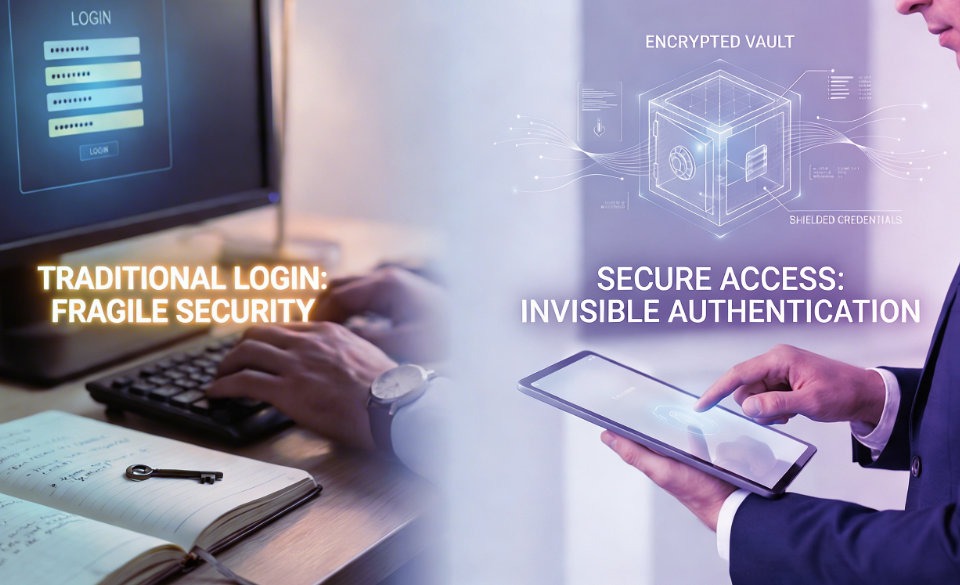
The End of the Shared Password Era
1. Access as the new security perimeter
From the first corporate directories to modern identity architectures, passwords have been the backbone of access to corporate systems for decades. With remote work, cloud, distributed environments, and massive remote access, that model has collapsed under its own fragility. The security conversation is no longer about how to better manage passwords, but how to eliminate them progressively. The concept of passwordless (password-free access) and invisible identity management architectures are mature responses to a truth that security teams know, but many are still reluctant to face: the user is the most vulnerable link in the trust chain.
In a modern Zero Trust approach, the perimeter is no longer a network or firewall; it’s the identity itself and how it is validated. And if that identity relies on secrets that the user can see or remember, then that perimeter is inherently insecure.
2. The structural problem: “Possession” of the key Is the vulnerability
Passwords have structural flaws that no complexity, expiration, or length policy can fix:
- Reuse: A single credential reused across personal and corporate services can be the master key to an attack. Studies show employees reuse passwords across multiple accounts, amplifying the risk of massive credential compromise.
- Phishing and social engineering: If the user knows the password, they can be manipulated into giving it away on a fake portal or phishing campaign.
- MFA fatigue and MFA failures: The 2022 Uber security incident showed that even with MFA enabled, the MFA fatigue technique allowed access by flooding the user with authentication requests until one was approved, enabling attackers to pivot to critical assets.
- Leaks and password reuse: Billions of credentials continue to circulate on the Dark Web following breaches of public or private services.
According to reports like Verizon DBIR, over 80% of breaches are related to compromised credentials, through theft, phishing, keyloggers, or reuse. The problem is not the password itself, but that users have access to them.
3. Real cases: when knowledge becomes a systemic risk
3.1 Colonial Pipeline (May 2021): One Password, a Critical Blackout
The ransomware attack on Colonial Pipeline is a textbook case in access models. An attacker gained access through a reused and compromised VPN account password, with no MFA enabled. This led to significant breaches in IT infrastructure and forced the shutdown of a critical U.S. pipeline, impacting fuel supply and triggering political pressure.
Key takeaway: One reused credential led to a systemic attack affecting 45% of the East Coast’s fuel supply. Without a model that eliminates user-held secrets, a single human error can result in total compromise of critical infrastructure.
3.2 Uber (2022): MFA Is Not Enough If the User Remains in Control
The Uber incident revealed a social engineering variant known as MFA fatigue: attackers bombarded a contractor with MFA requests until one was approved. Once inside, they used scripts with plaintext credentials to escalate privileges.
This emphasizes that even with mandatory MFA, the model still relies on human decisions, making it exploitable.
4. The paradox of password managers: real solution or cosmetic patch?
Corporate password managers emerged to mitigate obvious password flaws: generate strong passwords, store them encrypted, and help avoid reuse. However, they don’t solve the root problem:
- Still rely on a master password, which becomes a single point of risk.
- Users can still see and copy passwords, leaving them exposed to phishing or compromised endpoints.
- If the endpoint is insecure, the entire vault of passwords is exposed.
The real leap is not in storing the keys better, but in ensuring users never touch or see them.
5. Password management vs. passwordless environments: the future of corporate access
5.1 What Is a passwordless environment?
A passwordless environment eliminates the reliance on static passwords and replaces them with robust mechanisms based on standards like FIDO2 (WebAuthn + CTAP), public-private keys, biometrics, and device- or context-based authentication, without requiring the user to know or remember secrets.
Key benefits:
- Eliminates phishing: no password to steal.
- Reduces attack vectors like credential stuffing or brute force.
- Improves productivity by simplifying or automating access.
- Greater resilience to social engineering and MFA bypass.
Leading companies are integrating passwordless access directly into their platforms and products.
5.2 Virtualization as a catalyst for passwordless models
Access and desktop virtualization (VDI, remote isolated environments) act as a technological bridge toward a truly secure passwordless model:
- Users don’t interact directly with critical systems.
- Credentials aren’t entered or stored on local endpoints.
- Sessions and access are managed from a centralized, controlled layer, reducing risks like keyloggers, malware, or credential theft.
This not only facilitates the transition to passwordless but makes total password elimination practical and scalable.
6. Cosmikal and the gradual elimination of passwords
The Endurance architecture for accessing critical assets goes beyond managing secrets or traditional MFA:
6.1 Access via Encrypted Vault and Blind Execution
Instead of users possessing secrets, Cosmikal deploys an encrypted Vault where:
- Credentials are injected transparently into sessions without users ever seeing, copying, or handling them.
- Users never view the password, preventing leaks or memorization.
- Phishing risk vanishes because there’s no visible secret to steal.
- Credentials remain within the secure Endurance perimeter, even if the endpoint is compromised.
This model aligns with industry passwordless best practices: users are not trusted as secret custodians; instead, automated and cryptographically robust systems manage authentication and access.
7. Operational and security benefits of the passwordless model
Adopting a passwordless model based on architectures like Cosmikal provides clear, measurable advantages:
- Practically eliminates phishing as a primary attack vector.
- Drastically reduces incidents related to stolen or compromised credentials.
- Increases resilience to social engineering and MFA fatigue.
- Simplifies audits, compliance, and access traceability.
- Improves user productivity and experience without sacrificing security.
8. Conclusion: from managing passwords to eliminating the problem
The history of corporate access security shows that adding more complexity to passwords doesn’t make them safer, it only increases friction and support costs. Real-world cases like Colonial Pipeline and Uber prove that relying on human-held secrets and traditional MFA is not a fail-proof strategy.
The future of corporate access is not a stronger password or a better manager: it’s a model where the password is no longer required, visible, or manageable by users, and where access is controlled through automated, trustworthy systems that remove human error from the equation.
With passwordless environments reinforced by virtualization and blind execution architecture like Endurance, organizations not only better protect their assets, they design their systems to eliminate human error as a risk.